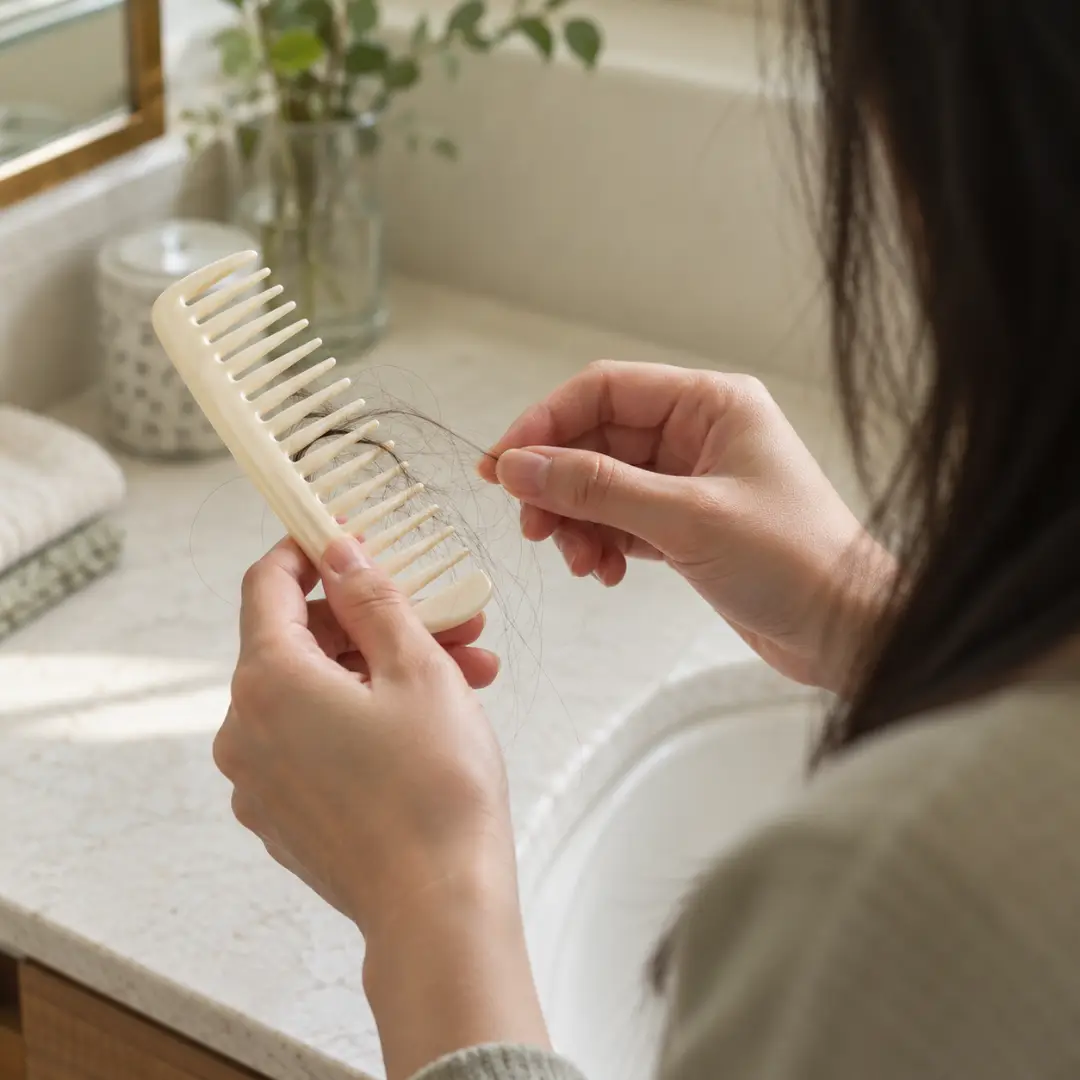
A change in hair density does not always begin with a handful of shed strands. Your ponytail may feel slimmer, photographs may reveal more scalp at the crown, or a once softly concealed part may become increasingly visible.
For many people, the first response is to buy a hair supplement. Nutrition does matter to hair health, but finer, sparser hair is not always simply a sign of an inadequate diet. Choosing an appropriate approach begins with understanding what is changing.
Increased shedding and progressively finer hair can have different causes
Telogen effluvium often presents as a noticeable increase in shedding over a relatively short period. Androgenetic hair loss can develop more gradually: some follicles progressively miniaturise, producing finer, shorter hairs that provide less coverage of the scalp.
The French Society of Dermatology describes progressively finer hair over the top of the head and a widening central part as common features in women. In men, thinning more often affects the temples and crown. These changes do not necessarily involve heavy shedding every day, and cannot be assessed or addressed through nutrition alone.
The value of supplementation depends on the need
Protein and a range of micronutrients contribute to normal body function. An association with hair health, however, does not mean that taking more will produce more hair.
The American Academy of Dermatology notes that a doctor may recommend supplementation when testing identifies a deficiency in iron, zinc or biotin. When levels are normal, extra supplementation may offer no benefit, and excessive intake can cause problems. Before purchasing several hair supplements, consider whether your diet has become overly restrictive or whether your weight has changed significantly, and let a doctor decide whether tests are appropriate.
The clearest purpose of nutritional supplementation is to address an actual shortfall, rather than treating every change in hair density as a nutritional problem.
Where do Hair Force and Densihair Capsules fit?
cel.estetic Hair Force contains zinc, selenium, copper, B vitamins and amino acids, offering nutritional support as part of a hair-care routine.
ToskaniMED Densihair Boost Capsules contain biotin, zinc, selenium, amino acids and saw palmetto ingredients, and are also an oral nutritional supplement.
Selection should take account of your diet, other supplements and any medicines you use, helping to avoid duplicate intake of the same ingredients. These products may be incorporated according to individual needs, but their inclusion of hair-related nutrients does not establish them as treatments proven to reverse follicular miniaturisation.
Explore cel.estetic Hair Force →
Explore ToskaniMED Densihair Boost Capsules →
Understand the scalp before considering professional care
When thinning persists, a professional assessment can examine differences in hair diameter, the distribution of loss and any accompanying scalp problems. A doctor can also use your history to decide whether nutritional or other investigations are needed; the same set of tests is not necessary for everyone.
Within professional scalp care, cel.estetic C-EM Hair Growth contains growth factors and a vitamin complex. ToskaniMED Densihair Boost Complex contains copper tripeptide, SH-Polypeptide-1, SH-Oligopeptide-2 and amino acids. Both are professional care formulations that should be selected following assessment by trained practitioners and used according to product protocols.
Suitability depends on the actual scalp condition and the procedure involved. Ingredient names alone do not demonstrate that a finished product works equally across all forms of hair loss, and these products cannot replace medical treatment where it is needed.
Explore cel.estetic C-EM Hair Growth →
Explore ToskaniMED Densihair Boost Complex →
Use comparable records to understand real change
Instead of repeatedly checking the mirror under different lighting, take periodic photographs with a consistent angle, parting and light, and review them alongside professional assessments. Hair changes take time. Consistent records help distinguish changes in density from the visual effects of lighting and styling.
For progressively finer hair, understanding the cause is the most useful first investment. When nutritional support, everyday care and treatment each have a clear role, the overall plan becomes easier to maintain and its results easier to assess.
References
1. Société Française de Dermatologie / Dermato-INFO. Tout savoir sur l’alopécie androgénétique.
2. Dermato-INFO. Connaitre les examens et traitements de l’alopécie androgénétique.
3. American Academy of Dermatology (AAD). Hair loss: Diagnosis and treatment.
4. cel.estetic. Total Hair Solution.
5. Dermatriz. Densihair Boost Capsules.